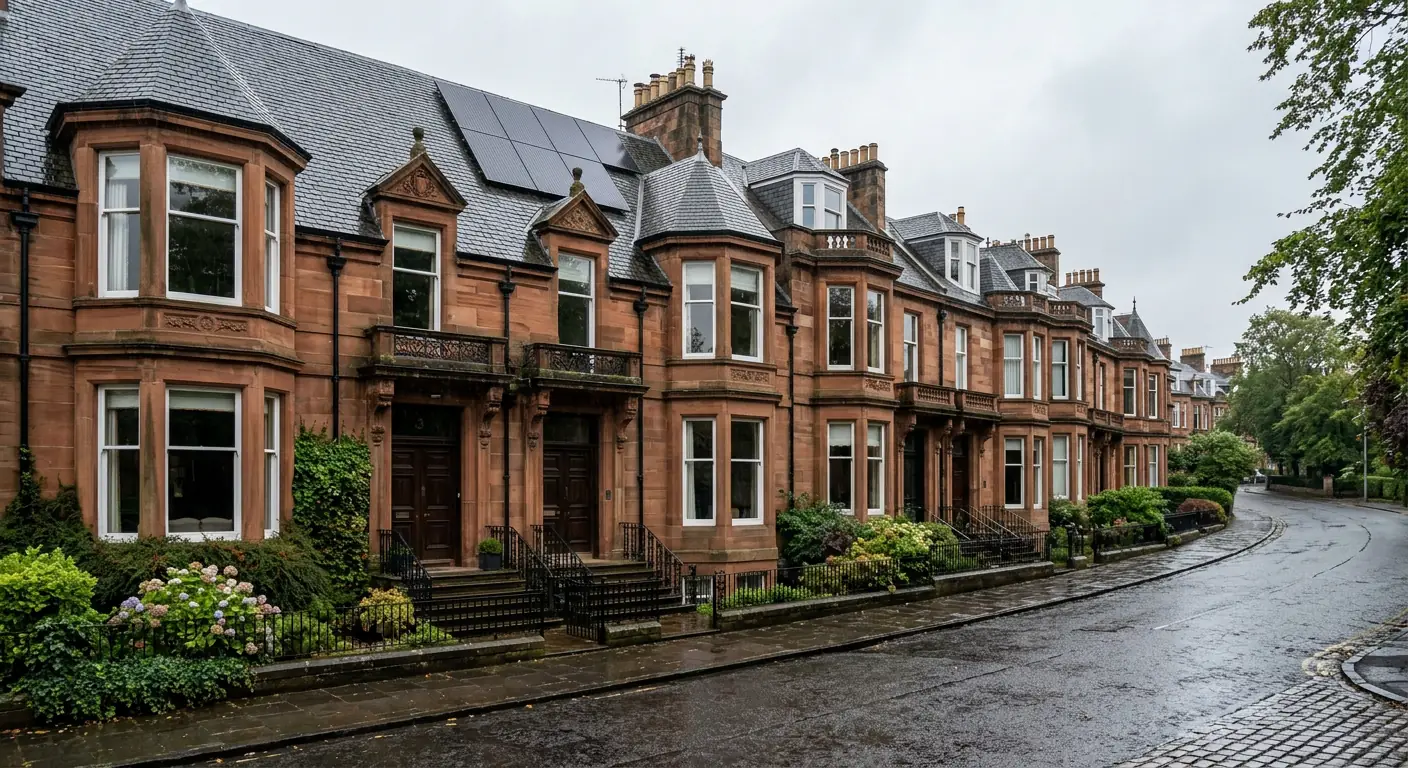
Do solar panels work in Glasgow's weather?
Yes. Solar panels generate from daylight, not heat, so they still produce power under Glasgow's cloud, just less than on bright days. Long summer days in Scotland help make up for grey winters. A survey using your exact roof and location gives you a realistic yearly estimate rather than a guess.
Winter output is low across Scotland, so most generation comes between spring and early autumn. Modern monocrystalline panels handle diffuse light well, which suits the west of Scotland, and cooler temperatures help too, because panels lose a little efficiency when they get hot.
Ask your installer for a month-by-month estimate so you know what to expect in December as well as June, and how much of that power you are likely to use at home.
Can I put solar panels on a Glasgow tenement?
Often, yes, but it takes more planning than a house. A tenement roof is usually shared by every owner in the building, so you will normally need agreement from your neighbours before work can start. Access, cable routes and where the inverter goes also need to be worked out in advance.
Many Glasgow tenements have pitched slate roofs, sometimes with valleys or dormers that limit usable space. Some buildings choose a shared system, while others agree that one owner may use part of the roof.
Your title deeds and any factor arrangements matter, so speak to your factor early. If the building is listed or in a conservation area, extra permissions are likely.
Do I need planning permission for solar panels in Glasgow?
For most houses, roof-mounted solar panels fall under permitted development in Scotland, so a full planning application is not needed. The rules are different for listed buildings, flats and conservation areas, which include much of the West End. Your installer should check this with Glasgow City Council before quoting.
Permitted development comes with conditions, such as panels not standing too far proud of the roof surface. If permission is needed, allow extra weeks for a decision.
Listed building consent is a separate process and is needed for works that affect the character of a listed building. A good installer will tell you honestly if approval looks unlikely.
How is a solar system connected to the grid in Glasgow?
Glasgow is served by SP Energy Networks, the local distribution network operator. Smaller systems are usually connected first and notified afterwards under a process called G98. Larger systems, or those with big batteries, need approval before installation under G99. Your installer handles this paperwork for you.
G98 generally covers systems exporting up to 16 amps per phase, roughly 3.68 kW on a typical single-phase home. Above that, approval can take several weeks, so ask early whether your design needs G99.
Once your system is commissioned, you can register for a Smart Export Guarantee tariff with an electricity supplier. This needs the MCS certificate for your installation.