Technical Guide
Solar Panel Technology for Scotland — Monocrystalline vs Polycrystalline
Last updated: 28 October 2026
Monocrystalline solar panels are the recommended choice for Scottish homes. They reach 20–23% efficiency and perform noticeably better than polycrystalline panels in Scotland's cloudy, diffuse-light conditions, meaning more electricity from the same roof space across Edinburgh, Glasgow, Aberdeen, or anywhere in Scotland. We install through MCS-certified partners.
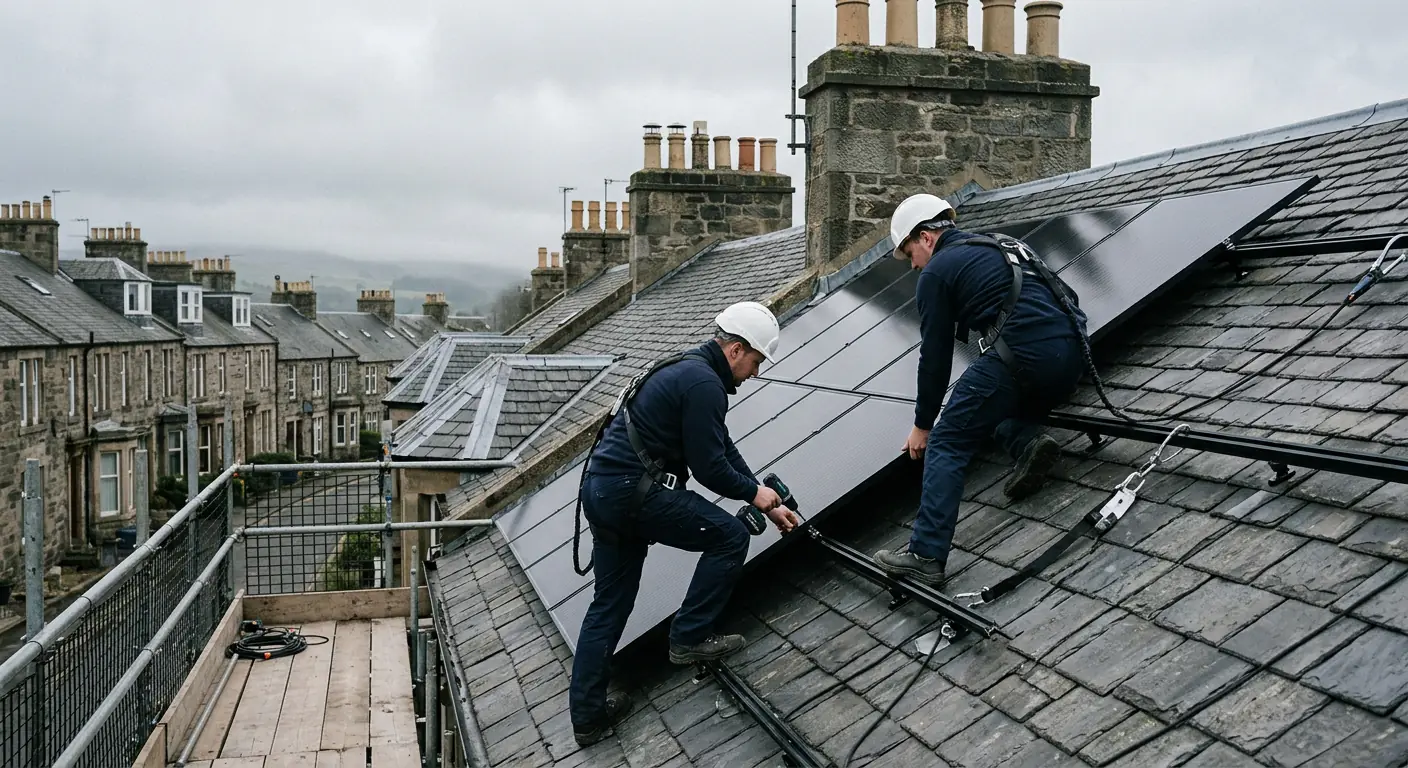
Monocrystalline silicon solar panels are the recommended choice for Scottish homes due to their strong performance in diffuse and indirect light conditions that characterise Scotland's climate. With efficiencies of 20–23% compared to 15–17% for polycrystalline, and better low-light performance, monocrystalline panels generate significantly more energy per square metre across Scotland's frequently overcast skies. Call 0141 230 0198 for an assessment.
Why does solar panel technology matter in Scotland?
Scotland gets far more diffuse light than direct sunshine, so panel type has a bigger impact on output here than in sunnier climates.
Diffuse light is indirect sunlight that has been scattered by clouds, atmospheric particles, and other factors. This fundamental characteristic of Scottish weather means that panel technology selection has a major impact on system performance.
What are monocrystalline solar panels and how do they perform?
Monocrystalline panels use single-crystal silicon to reach 20–23% efficiency — the highest of any residential panel type and ideal for Scotland's overcast skies.
The single-crystal structure allows electrons to move more freely, resulting in higher efficiency and better low-light performance.
Monocrystalline Advantages for Scotland:
- 20–23% efficiency: More power per square metre
- Superior diffuse light performance: Maintains output in overcast conditions
- Better temperature coefficient: More efficient in Scotland's cool climate
- Longer warranties: 25–30 years typical
- Space-efficient: Fewer panels needed for target output
Which monocrystalline panel brands are used in Scottish installations?
Longi Hi-MO, JA Solar, and Jinko Tiger are the primary brands specified — all achieve above 22% efficiency with 12–25 year product warranties.
These premium monocrystalline panel manufacturers are chosen for their proven performance in Scottish conditions:
Longi Hi-MO
JA Solar
Jinko Tiger
How do monocrystalline and polycrystalline panels compare?
Monocrystalline delivers 20–23% efficiency versus 15–17% for polycrystalline, with noticeably better output in Scotland's cloudy, diffuse-light conditions.
Here's how the three main solar panel technologies compare for Scottish installations:
| Specification | Monocrystalline | Polycrystalline | Thin Film |
|---|---|---|---|
| Efficiency | 20-23% | 15-17% | 7-13% |
| Diffuse light performance | Excellent | Good | Good |
| Temperature coefficient | Better | Average | Best |
| Scotland suitability | Ideal | OK | For flat roofs |
| Our recommendation | Yes - All installs | — | Flat roofs only |
Technical note: We use monocrystalline panels for all Scottish installations due to their superior performance in Scotland's diffuse light conditions and better temperature coefficient.
Why are polycrystalline panels not recommended for Scotland?
Their lower 15–17% efficiency and weaker diffuse-light performance mean less energy per panel — the small upfront saving is lost to reduced generation over 25 years.
While polycrystalline panels are less expensive, their reduced low-light performance makes them a poor choice for Scotland. For Scottish conditions, monocrystalline is always the better investment.
How does Scotland's climate affect solar panel performance?
Cool temperatures boost panel efficiency, frequent rain keeps panels clean, and long summer daylight hours offset shorter winters — but diffuse light demands high-efficiency panels.
Scotland's climate presents unique challenges and advantages for solar installations: